The other day a park visitor from Germany who'd just been reading in his guidebook about sea otters asked me "What is 'sea urchin'?" and after I failed at describing it through the language barrier, we walked across the whale overlook to where purple sea urchins are pictured on one of the columns. Immediate recognition - "Ahhh!" - was followed by a lively conversation in two languages about etymology. Thank goodness for iPhone translation apps.
All over the rest of the world, these are apparently known as sea hedgehogs. Totally makes sense. Unless you're from North America, where there are no native hedgehogs. Or England, which is where the 16th-century slang term "urchin" was coined, referring first to hedgehogs themselves, and then to people with physical deformities that caused rounding of the spine, then generalized to encompass anyone with physical deformities, and then eventually street people; anyone who, in that time period, was most likely to be a beggar. After awhile it was applied more to street children and less to the disabled...and the term traveled to North America that way.
So: purple sea urchin = purple sea hedgehog = Strongylocentrotus purpuratus.
Otters aren't the only ones who eat urchins. We do too. Sushi has been so assimilated into the American diet that it's no longer uncommon. And uni is a standard offering at most sushi restaurants. Uni is the roe of red sea urchins (S. franciscanus) -- the eggs. Sea otters eat all varieties of urchins, but we prefer red urchins; their roe is more popular and considered high quality than the roes from purple urchins. Red urchins are harvested off the coast of California, in the deeper waters around kelp forests; the same places sea otters feed.
I could totally go off on so many tangents here: neoteny, our preference for "saving" species we find cute (otters, not urchins), competition for resources, the balances of conservation management, etc., but I'll resist. All things to reflect on, the next time you eat uni. If you're a fan of uni.
You can read more about sea hedgehogs and sea otters here.
Friday, October 5, 2012
Monday, October 1, 2012
Viewmaster
A front blew in this morning, and by noon you couldn't see a thing at Cabrillo. Unlike other foggy times, it stayed blowy, and the blowier it got, the denser the fog got. Visitors struggled to keep their clothes on. After awhile even I couldn't take the winds another minute, and left early.Needless to say, there was no view. Normally, I take snapshots as I'm pushing my cart around, gathering differing viewpoints and juggling ideas for composition. And I cheat: I always carry a ViewCatcher, this little photography tool. It's particularly helpful someplace like Cabrillo, where there's such a feast of visuals to gorge on. A ViewCatcher makes me focus. Like Adderall for the eyes.
Although practicing composing with a tool like this helps develop skills for 3-d work, too, most of the information out there about viewpoints in composition refers to 2-d work. It translates just fine to 3-d. Here's an excellent posting on a photographer's blog about viewpoints and composition...much more thorough than I could write. Or would want to write.
Specific to painting, my friend Terry Miura also has a great post here about differing POVs.
That Thing I Do
"Artist in Residence? What's that?"is something Cabrillo visitors ask all the time. Friends tend to say "A residency! How awesome that for awhile you get to spend all your time making art!" This residency IS awesome, but not in the way you might think; not that way.
The reality of making art for a profession is that only a percentage of your working time is spent making art. Even in my home studio, I spend just about a third of my time actually sculpting or painting, a percentage which encompasses all the creative stages, including parts you might not think of as "making": design and planning (both mental and on paper), the less visible construction aspects of art-making, finish work, and photographing and documenting the work. Tedious chores like reconstituting clay, making supports and molds, and assembling cradled panels, armatures, stretchers, and frames eat up a chunk of the art-making third, too. So do grinding, sandblasting, setting up for spraying, glazing, loading or unloading a kiln...as well as the myriad problem-solving adjustments that are normal bumps in the flow of creativity.
What is NOT art-making? Grunt work that keeps the art-making process lubricated: studio and equipment cleaning, repairs, general physical maintenance, shopping and transportation of supplies, various organizational tasks. Chalk up another third here. Commercially successful artists have assistants who handle this portion, so they can focus more on creation. (Very successful artists even have assistants who are artists in their own right, subcontractors really, who create artworks for them. Dale Chihuly and Damien Hirst come immediately to mind.)
The final third is needed to attend to marketing, communications, paperwork, and the business-keeping end of things. If you're an artists who can afford to employ secretaries, accountants, publicists, business managers...awesome. The rest of us learn to do these things ourselves.
There's variation in all these proportions, of course. On a good run, I'll choose to spend an entire week doing nothing but making, and let the other things slide. Or, conversely, marketing or grunt work sometimes demand enough time that a week passes without even an hour devoted to creativity.
Art residencies should in theory increase your art-making time; that is their point. With good planning, you can suspend your ordinary business tasks during a residency. And in some instances there's residency staff who maintain and organize the studio provided to you, who help you out. Ideally, a residency intends to expand that one-third allotment of creative time - substantially.
To this end, most residencies provide you with studio space. It could be bare-bones, or well-furnished, or in between. Some give you an equipment and supplies allowance so you can get your own things to the residency. Many (including most NPS residencies) also give you housing, which is typically on the same site as the studio...a real time-saver. Some provide your meals: the food and the prep, cooking, and cleaning up after! More time saved.
And then there are a few truly wonderful, prestigious and very competitive residencies that provide studio, housing, your meals, AND pay you a stipend.
Others require you to pay them for the privilege of the residency (I don't think any artist really likes these. I don't even see how they get to call themselves residencies.) But the vast majority are cost-neutral: you neither pay for the residency, nor receive pay. All National Park Service residencies are. (But even within this category where no cash changes hands, there's tremendous variation in terms of the benefits provided.)
The facts of my residency at Cabrillo are that it's unfunded, and provides no studio, no housing, no meals. I saved up money to be able to do this residency, just as I'd save for a vacation. I prepared a budget for myself. Fuel is by far my biggest expense, a whopping item on my budget. By the time I pick up my work after the exhibition, I will have made five separate round-trip drives of 1,000 miles each from my home city to San Diego, plus one round-trip airplane flight (short notice; no discount for early booking) for the final interview; plus roughly $50 in gas each week for the 7 weeks I'm here, just to commute between the park and where I'm staying in San Diego.
That is a lot of gasoline.
That's also a substantial amount of time that's not being spent making art. Alas. It takes an hour and a half just to drive back and forth from where I'm staying to the park. And although there's no charge where I'm staying (I'm essentially housesitting), I have chores instead, as a courtesy to the homeowner. Because I had to bring my dog with me, there's also time spent on pet care. Because I'm conserving funds by not eating out, I spend more time on grocery shopping and preparing meals. The place I'm staying doesn't have a dishwasher, so I also spend an old-fashioned housewives amount of time on meal preparation and cleanup. Or, I would if I washed the dishes regularly. Which I don't. Because when I'm at the house, I'm still working mostly on art. The dishes can wait.
And I'm writing this blog. And spending time preparing for 3 different outreach programs I'll be doing.Whew. If I could figure out a way to sleep during the commute, I'd be set.
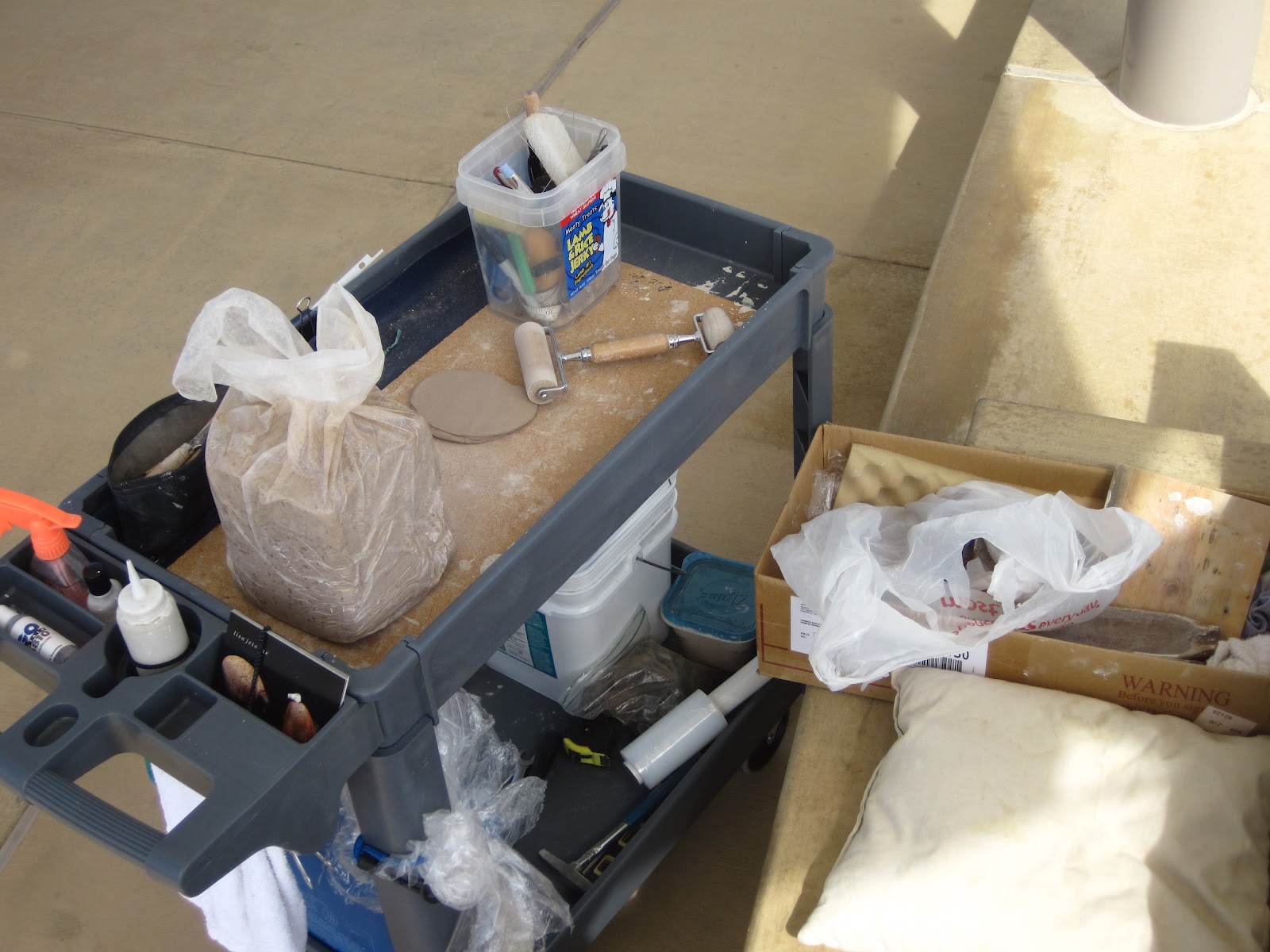
There's no studio at Cabrillo, so I work off a rolling cart when I'm at the park, and I've set up a makeshift little studio where I'm staying. Actually, 2 makeshift "studio" spaces: one in the kitchen just for painting...
and one in the garage for sculpture: a workbench and a table, about 20 square feet of space.
Here's my working space at the park. It's very mobile, in paved areas. Often I take it to the whale overlook because there's a shade canopy. In the afternoon, I roll it back to the NPS administrative offices, transfer the damp sculptures to my car, finish the work later in the "studio" where I'm staying, and the next day bring a fresh bag of clay to the park.
Wednesday, and most Mondays, I've been at the whale overlook with the cart. A couple of times I've taken it to the lighthouse too. When I'm working at one of the other, unshaded overlooks in the park -- the ones you can drive to (the cove overlook, coast overlook, the first view overlook, and tidepool overlook) -- I work out of the trunk of my car.
So by necessity I work small. Paintings are just 8 inches square; sculptures are goblet to pitcher-sized, mostly maquettes or studies. At the end of October I'll go home for a month, take one or two of the best studies, and make larger sculptures of them. At the end of November I'll bring everything back (the studies, too) and install the exhibition for the December 1st opening.
So, you might ask, what exactly am I getting out of this unfunded, no-housing, no-studio residency? Aside from the freedom to break away from my ordinary studio routines? To spark new ideas? Aside from the rare opportunity to make sculpture en plein air? An abundance of inspiration, foremost. A few hours at the tidepools, or the whale or coast overlooks, or the bayside trail, or on the point watching the harbor, or soaking up the military and cultural history, and your creative soul is flooded with beauty and inspiration. For me, there's sufficient inspiration at Cabrillo to last a lifetime of art-making. A bonus is the beautifully odd and serendipitous connections I've made with visitors (and park staff!). I've talked with visitors from all over the world, from all kinds of backgrounds, and again this is an invaluable source of creative inspiration.
It's turning out to be an amazing experience.
The reality of making art for a profession is that only a percentage of your working time is spent making art. Even in my home studio, I spend just about a third of my time actually sculpting or painting, a percentage which encompasses all the creative stages, including parts you might not think of as "making": design and planning (both mental and on paper), the less visible construction aspects of art-making, finish work, and photographing and documenting the work. Tedious chores like reconstituting clay, making supports and molds, and assembling cradled panels, armatures, stretchers, and frames eat up a chunk of the art-making third, too. So do grinding, sandblasting, setting up for spraying, glazing, loading or unloading a kiln...as well as the myriad problem-solving adjustments that are normal bumps in the flow of creativity.
What is NOT art-making? Grunt work that keeps the art-making process lubricated: studio and equipment cleaning, repairs, general physical maintenance, shopping and transportation of supplies, various organizational tasks. Chalk up another third here. Commercially successful artists have assistants who handle this portion, so they can focus more on creation. (Very successful artists even have assistants who are artists in their own right, subcontractors really, who create artworks for them. Dale Chihuly and Damien Hirst come immediately to mind.)
The final third is needed to attend to marketing, communications, paperwork, and the business-keeping end of things. If you're an artists who can afford to employ secretaries, accountants, publicists, business managers...awesome. The rest of us learn to do these things ourselves.
There's variation in all these proportions, of course. On a good run, I'll choose to spend an entire week doing nothing but making, and let the other things slide. Or, conversely, marketing or grunt work sometimes demand enough time that a week passes without even an hour devoted to creativity.
Art residencies should in theory increase your art-making time; that is their point. With good planning, you can suspend your ordinary business tasks during a residency. And in some instances there's residency staff who maintain and organize the studio provided to you, who help you out. Ideally, a residency intends to expand that one-third allotment of creative time - substantially.
To this end, most residencies provide you with studio space. It could be bare-bones, or well-furnished, or in between. Some give you an equipment and supplies allowance so you can get your own things to the residency. Many (including most NPS residencies) also give you housing, which is typically on the same site as the studio...a real time-saver. Some provide your meals: the food and the prep, cooking, and cleaning up after! More time saved.
And then there are a few truly wonderful, prestigious and very competitive residencies that provide studio, housing, your meals, AND pay you a stipend.
Others require you to pay them for the privilege of the residency (I don't think any artist really likes these. I don't even see how they get to call themselves residencies.) But the vast majority are cost-neutral: you neither pay for the residency, nor receive pay. All National Park Service residencies are. (But even within this category where no cash changes hands, there's tremendous variation in terms of the benefits provided.)
The facts of my residency at Cabrillo are that it's unfunded, and provides no studio, no housing, no meals. I saved up money to be able to do this residency, just as I'd save for a vacation. I prepared a budget for myself. Fuel is by far my biggest expense, a whopping item on my budget. By the time I pick up my work after the exhibition, I will have made five separate round-trip drives of 1,000 miles each from my home city to San Diego, plus one round-trip airplane flight (short notice; no discount for early booking) for the final interview; plus roughly $50 in gas each week for the 7 weeks I'm here, just to commute between the park and where I'm staying in San Diego.
That is a lot of gasoline.
That's also a substantial amount of time that's not being spent making art. Alas. It takes an hour and a half just to drive back and forth from where I'm staying to the park. And although there's no charge where I'm staying (I'm essentially housesitting), I have chores instead, as a courtesy to the homeowner. Because I had to bring my dog with me, there's also time spent on pet care. Because I'm conserving funds by not eating out, I spend more time on grocery shopping and preparing meals. The place I'm staying doesn't have a dishwasher, so I also spend an old-fashioned housewives amount of time on meal preparation and cleanup. Or, I would if I washed the dishes regularly. Which I don't. Because when I'm at the house, I'm still working mostly on art. The dishes can wait.
And I'm writing this blog. And spending time preparing for 3 different outreach programs I'll be doing.Whew. If I could figure out a way to sleep during the commute, I'd be set.
There's no studio at Cabrillo, so I work off a rolling cart when I'm at the park, and I've set up a makeshift little studio where I'm staying. Actually, 2 makeshift "studio" spaces: one in the kitchen just for painting...
and one in the garage for sculpture: a workbench and a table, about 20 square feet of space.
Here's my working space at the park. It's very mobile, in paved areas. Often I take it to the whale overlook because there's a shade canopy. In the afternoon, I roll it back to the NPS administrative offices, transfer the damp sculptures to my car, finish the work later in the "studio" where I'm staying, and the next day bring a fresh bag of clay to the park.
So by necessity I work small. Paintings are just 8 inches square; sculptures are goblet to pitcher-sized, mostly maquettes or studies. At the end of October I'll go home for a month, take one or two of the best studies, and make larger sculptures of them. At the end of November I'll bring everything back (the studies, too) and install the exhibition for the December 1st opening.
So, you might ask, what exactly am I getting out of this unfunded, no-housing, no-studio residency? Aside from the freedom to break away from my ordinary studio routines? To spark new ideas? Aside from the rare opportunity to make sculpture en plein air? An abundance of inspiration, foremost. A few hours at the tidepools, or the whale or coast overlooks, or the bayside trail, or on the point watching the harbor, or soaking up the military and cultural history, and your creative soul is flooded with beauty and inspiration. For me, there's sufficient inspiration at Cabrillo to last a lifetime of art-making. A bonus is the beautifully odd and serendipitous connections I've made with visitors (and park staff!). I've talked with visitors from all over the world, from all kinds of backgrounds, and again this is an invaluable source of creative inspiration.
It's turning out to be an amazing experience.
Saturday, September 29, 2012
Trapped
I spent a couple of hours last week learning all there is to know about commercial lobster traps. At least my brain and notepad are so packed with information that it feels like I learned everything; in reality you could write whole books about this subject. (A big thank you to Don at C & M Wire Products for spending his morning educating me. He also referred me to the president of the California Lobster Trap Fisherman's Association, but first I have to finish digesting all of Don's information!)
Obviously, marine debris is a huge problem, globally. I also attended a lecture on the Pacific Garbage Patch, a huge floating accumulation of mostly plastic debris in the Pacific Gyre. If you've heard of the Pacific Garbage Patch, maybe you've seen this photo? (Which is NOT a photo of the Pacific Garbage Patch!)
In reality, this picture was taken somewhere in or around the Manila harbor, but on the world wide web it's often wrongly attributed to the Pacific Garbage Patch. And while microplastics, floating debris, and the Pacific Garbage Patch are tremendous problems that need resolution, it's accumulations of trash in harbors - such as that pictured above - which relate to lobster traps. Which in turn relates to my art-making at Cabrillo: one of my projects may be to attempt a large sculpture re-using materials from lobster traps. Because, sadly, lobster trap debris is a typical feature of Cabrillo National Monument. Although they don't float, lost lobster traps frequently do wash up on the rocky coast of Point Loma, and at low tide are caught on riprap. Visitors don't often see them for several reasons: areas where currents tend to deposit them aren't areas readily visible from public overlooks; because they don't float, they tend to be uncovered only at the lowest tides, which many times occur during hours the park is closed; and those times when it is uncovered, NPS rangers and the Coast Guard clean it up pretty quickly.
It's the commercial traps that mostly wash up, not recreational traps - which are a different type of material. Commercial traps are big, bulky boxes assembled from a heavy wire mesh that's coated first with zinc, then powder-coated with PVC. (The zinc and plastic protect the metal mesh from corrosion; traps in annual use last a number of years.) The mesh panels are assembled into compartmentalized boxes, using galvanized metal clips. Right now my difficulty is in removing the galvanized clips, so that I can use the panels in making a sculpture. Since the clips are applied very tightly with a pneumatic gun, it's proving to be a problem...a bigger problem than I'd anticipated.
More about marine debris later...
Obviously, marine debris is a huge problem, globally. I also attended a lecture on the Pacific Garbage Patch, a huge floating accumulation of mostly plastic debris in the Pacific Gyre. If you've heard of the Pacific Garbage Patch, maybe you've seen this photo? (Which is NOT a photo of the Pacific Garbage Patch!)
In reality, this picture was taken somewhere in or around the Manila harbor, but on the world wide web it's often wrongly attributed to the Pacific Garbage Patch. And while microplastics, floating debris, and the Pacific Garbage Patch are tremendous problems that need resolution, it's accumulations of trash in harbors - such as that pictured above - which relate to lobster traps. Which in turn relates to my art-making at Cabrillo: one of my projects may be to attempt a large sculpture re-using materials from lobster traps. Because, sadly, lobster trap debris is a typical feature of Cabrillo National Monument. Although they don't float, lost lobster traps frequently do wash up on the rocky coast of Point Loma, and at low tide are caught on riprap. Visitors don't often see them for several reasons: areas where currents tend to deposit them aren't areas readily visible from public overlooks; because they don't float, they tend to be uncovered only at the lowest tides, which many times occur during hours the park is closed; and those times when it is uncovered, NPS rangers and the Coast Guard clean it up pretty quickly.
It's the commercial traps that mostly wash up, not recreational traps - which are a different type of material. Commercial traps are big, bulky boxes assembled from a heavy wire mesh that's coated first with zinc, then powder-coated with PVC. (The zinc and plastic protect the metal mesh from corrosion; traps in annual use last a number of years.) The mesh panels are assembled into compartmentalized boxes, using galvanized metal clips. Right now my difficulty is in removing the galvanized clips, so that I can use the panels in making a sculpture. Since the clips are applied very tightly with a pneumatic gun, it's proving to be a problem...a bigger problem than I'd anticipated.
More about marine debris later...
Wednesday, September 26, 2012
One chance...
Today a navy ship spent the entire day going back and forth, back and forth, back and forth in the shipping lane; in and out of the harbor. See that ship in the background? That ship. If it were a zoo animal, we'd say it was stressed or bored. I bet this crew on this ship was bored, at least today, doing this. I don't know why it sailed back and forth. For practice? Just in case that person ever had to take over command of the ship? Or maybe some new ship's pilot was learning the ropes? Or did each and every person on board get a chance to make the run, and it just took all day? I had to wonder, too: were they practicing staying in the lane, or making the U-turn at each end? Perhaps a reader can enlighten me why ships make stereotypical movements.....
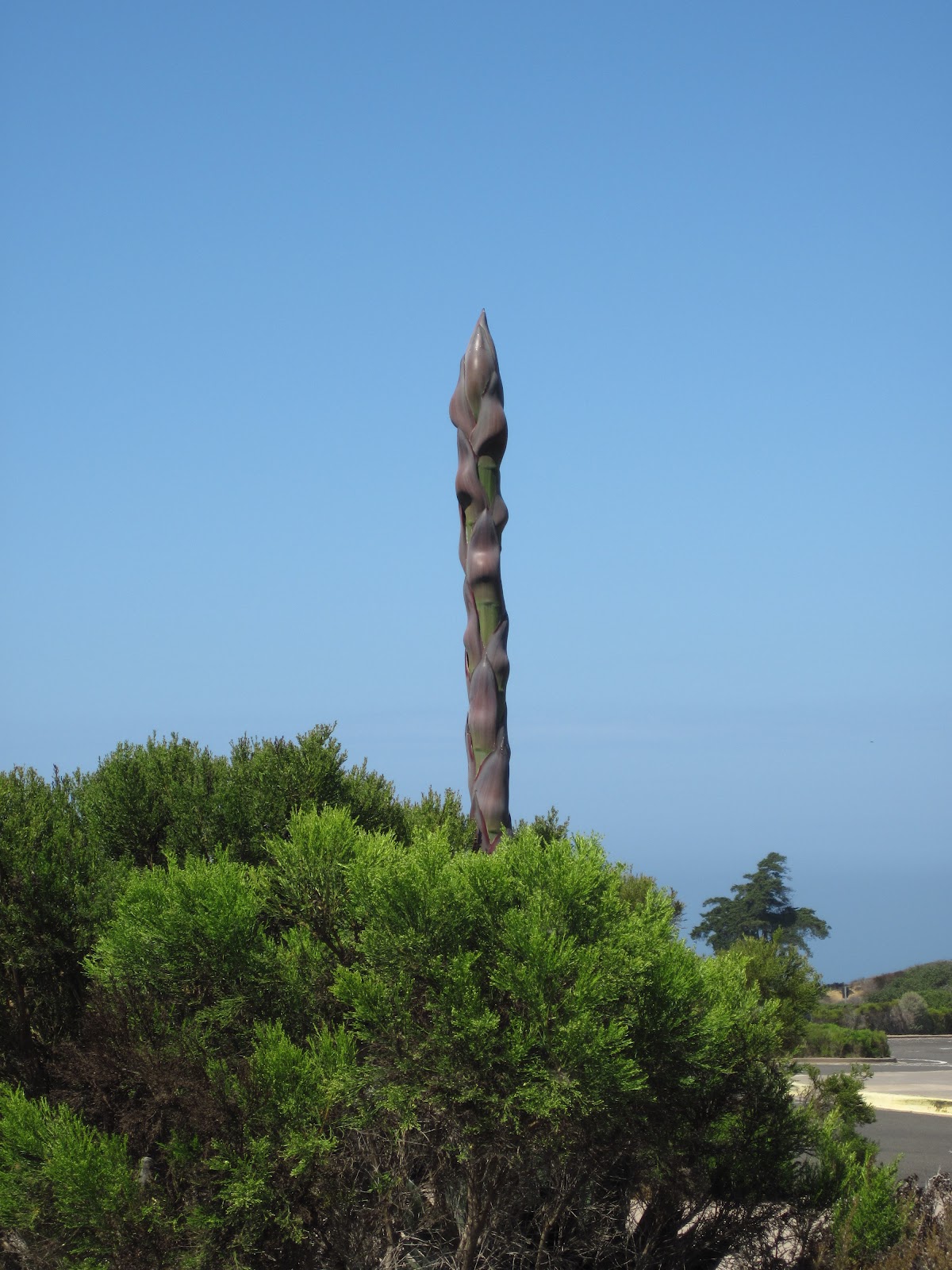
The plants in the foreground are Shaw's agave. It blooms only once, at maturity, which can take thirty or forty years. The flower emerges from a stalk around 12 feet tall.
It looks kind of like a giant asparagus, and in fact it's related to asparagus. The bloom looks like this. Pretty spectacular.
And then after it blooms, the whole plant dies.
Some things you only get one shot at in life.
Tuesday, September 25, 2012
The Short View
Many mornings are foggy on the point, as they tend to be all along the coast. (It is possible to check Cabrillo's online cameras before leaving the house, to get a look at the weather, in case you'd rather not come to the park unless it's clear.) Visitors arriving might be dismayed there's enough fog they can't see the ocean at all, but I'm thrilled when I arrive at the park to find thick fog. Sight obscured, my hearing seems more acute -- mostly because I'm paying better attention to it -- and I love the sound of the ocean when I can't see it. We are such visual creatures. It takes a veil of fog sometimes to remind us, in such a visually breathtaking environment, that our other senses can join the feast. You have to listen between the wails of the foghorn, is all.
Fog drip is an important source of water for plants and animals in this dry ecosystem. It's hard to see fog drip collecting on plants. But you can easily see it collecting on spider webs, beading up on the various web patterns in the most beautiful way. In fact, a day's new spider webs are ordinarily barely visible, if at all, on dry clear mornings. When fog erases the ocean, it's also easier to focus on the short view, what's immediately around you...and those beads of fog highlight the lines of silk normally invisible. Suddenly you notice there seem to be millions of spider webs; every plant on Cabrillo apparently a spider condominium, and they're all out barbequing. All the plants all draped with finely beaded silk doilies. Dragonflies and butterflies are out enjoying the rare moisture, too, and are easier to spot against the opaque white background. Possibly they'll meet... If you stake out one area and just sit still and watch, maybe you'll see a miniature Mutual of Omaha moment.
Friday, September 21, 2012
Genesis
One of the things I have to keep reminding myself of is that art residencies are not about cranking out production work, but about the generation of new ideas and new directions. Studio production isn't normally a steady trickle at home either. My ratio of research to production is heavier on the research side; I spend a fair amount of time on genesis, after which the artwork sort of gushes out all at once.
Here, alternating research-days with making-days has been a good strategy so far. This morning I'd planned to spend at the Coast Overlook, fine-tuning bird sculpture forms. Yesterday I was at the Mingei Art Museum Library doing research. I managed to squeeze in a bit of painting, too, but didn't feel much accomplishment. The other half the day was spend shopping for and making risotto, for a potluck send-off party honoring a couple of NPS folks moving to other parks. (And I'm kicking myself for not bringing any of my handmade ceramic serving dishes to San Diego. While I don't consider myself a potter, I certainly can make pots and have a collection of wood-fired serving dishes. And it's a traditional point of honor among ceramists to put on a good show for potlucks: a homemade dish, served in a handmade dish.)
So I was looking forward to a day of production today. Instead I spent the better part of the day learning all about commercial lobster traps. Which I'll write about in a later post, and until then you'll just have to trust me that lobster traps ARE related to art-making. In the meantime, I have nothing concrete to show for the morning's work except notebook pages and the glimmerings of ideas. And I am all about the concrete stuff, objects, things...the time spent on research really does pay off in the work. I'm also one of those people who, when I say I spent the better part of a day doing something, I really mean the "better" part. Morning is my favorite time to get things done, because almost everything feels like more of an accomplishment if it was done in the morning. Totally irrational, I know. At least I'll get a few hours at the park this afternoon working on actual art-making. Anyway, a big thanks to Don of C & M Wire Products for spending HIS whole morning educating me about the materials I'll be using in one of my sculptures!
Here, alternating research-days with making-days has been a good strategy so far. This morning I'd planned to spend at the Coast Overlook, fine-tuning bird sculpture forms. Yesterday I was at the Mingei Art Museum Library doing research. I managed to squeeze in a bit of painting, too, but didn't feel much accomplishment. The other half the day was spend shopping for and making risotto, for a potluck send-off party honoring a couple of NPS folks moving to other parks. (And I'm kicking myself for not bringing any of my handmade ceramic serving dishes to San Diego. While I don't consider myself a potter, I certainly can make pots and have a collection of wood-fired serving dishes. And it's a traditional point of honor among ceramists to put on a good show for potlucks: a homemade dish, served in a handmade dish.)
So I was looking forward to a day of production today. Instead I spent the better part of the day learning all about commercial lobster traps. Which I'll write about in a later post, and until then you'll just have to trust me that lobster traps ARE related to art-making. In the meantime, I have nothing concrete to show for the morning's work except notebook pages and the glimmerings of ideas. And I am all about the concrete stuff, objects, things...the time spent on research really does pay off in the work. I'm also one of those people who, when I say I spent the better part of a day doing something, I really mean the "better" part. Morning is my favorite time to get things done, because almost everything feels like more of an accomplishment if it was done in the morning. Totally irrational, I know. At least I'll get a few hours at the park this afternoon working on actual art-making. Anyway, a big thanks to Don of C & M Wire Products for spending HIS whole morning educating me about the materials I'll be using in one of my sculptures!
Thursday, September 20, 2012
Bird Sightings
Yesterday I saw a California Thrasher; have never seen one before. It was foraging around the lighthouse gardens. (The interpretive rangers keep a garden there similar to the one the lighthouse keeper family grew in the 1800s. And no doubt face the same challenges: although nearly everyone kept a garden for growing food in those days, sandstone and rock -- with extreme coastal weather -- doesn't provide ideal growing conditions.) It shot out of the brush in front of me, and from behind it looked like a roadrunner with that roadrunner-stride and those long tail feathers. Then it stopped and turned, and the bill gave it away; no other California bird has that combination of super-long tail and decurved bill.
I spent the day at the whale overlook, sculpting in clay, and a kite was hanging around all morning.
Elanus caeruleus
Beautiful to watch in flight; at first glance you might think you're watching a gull fly (the wings do look like gull's wings, and they hold them the same way), but that bullet head and falcon-like body are the giveaway clues. A raptor in Art Deco design.
Everyday sightings when you spend a day at at the park: pelicans, gulls, cormorants, red-tail hawks, hummingbirds, scrub jays, towhees.
I spent the day at the whale overlook, sculpting in clay, and a kite was hanging around all morning.
White-tailed Kite
(formerly Black-shouldered Kite)Elanus caeruleus
Beautiful to watch in flight; at first glance you might think you're watching a gull fly (the wings do look like gull's wings, and they hold them the same way), but that bullet head and falcon-like body are the giveaway clues. A raptor in Art Deco design.
Everyday sightings when you spend a day at at the park: pelicans, gulls, cormorants, red-tail hawks, hummingbirds, scrub jays, towhees.
Sunday, September 16, 2012
Tea Burglers
Fleet week has begun in San Diego, and I could be down at the cooler harbor, taking part, (we're having a record-breaking heat wave), but instead I'm luxuriating in AC, reviewing stacks and stacks of super-interesting information from the TPERP conference I attended all day Saturday at Cabrillo. Which was, thankfully, held in the only air-conditioned building at the park, the public auditorium. Yes, your park service rangers and staff at Cabrillo do without AC entirely; it's not installed in their offices, shops, meeting rooms, library, kiosks, or anywhere else they work, and last week has been so hot and humid that even going inside to use the restroom has been like punishment. Unless you're dressed for a sauna. Which might freak out the staff a little.
TPERP stands for Tidepool Protection, Education, Restoration, and Preservation. Unwieldy, right? Hence the acronym...which frankly wasn't easy to remember, either - until I thought of the mnemonic image of two burglars (perps) having tea. How do I know they're burglars? They're wearing masks. What did they burgle? Why, shells from the tidepools, of course. Like most government organizations, the NPS has a whole library of acronyms. I've been a military wife and we're military parents, quite used to abbreviations for everything that could possibly be acronym-ed, but I've yet to come across one that beats the complete gibberish of what was bestowed on our oldest son, who works for NOAA. His job title is fifteen words long. I'm not kidding. It's easier to explain what he does, which I don't even understand (if you have a degree in physics, you're welcome to try explaining it to me), than to remember his job title OR the grouping of acronyms that substitutes. And then there are letters after his name, too. It's a wonder he ever receives any official correspondence, it takes so long just to address him.
The TPERP conference trains docents to interact with tidepool visitors, provide natural history (and other park info), and to gently but firmly remind visitors of the rules that protect the wildlife there. Cabrillo is the third most-visited national NPS site; over 800,000 people a year. More then 200,000 of them visit the tidepool. No wonder they need protection! As the Cabrillo marine biologist says, imagine two hundred thousand people traipsing through your living room each year. The wear and tear on your carpet, the gradual accumulation of debris brought in from outside, the attrition of your personal belongings (each person thinking "I'm only taking this one water glass; they have so many dishes they'll never notice"), the pure STRESS of putting up with all those visitors.
If there was one word that summed up the creatures who live in the tidepools (or more correctly, live in the rocky intertidal; in fact, many don't live in the actual pools), it would be HARDY. Those dudes put up with a lot! It's an irrefutable fact of human nature that people do not cotton to change. Intertidal creatures live for change. Every quality of their environment changes constantly, from extreme to extreme. The tides are a gradient, always rising or falling; then there's variation dependent on the cycle of the moon, and environmental variation due to changing seasons, and there's weather variation. They also have to deal with the physical force of waves; wind; changes in humidity, salinity and temperature; and UV rays. Intertidal organisms are subjected to variations that can be as abrupt as a 40 degree drop in temperature within a few seconds; some creatures are wet by waves only a couple of times a month, and hold their breath in between those times. I would not want to live in the rocky intertidal.
But lest you think that "hardy" equates "tolerates handling", note that as in nature everywhere, surviving and thriving are not the same. Their feats of survival are dependent on the allocation of enormous physiological resources to dealing with their constantly changing environment; it's what they adapted for. They haven't adapted for being pried from their homes; being forcibly moved from one neighborhood where they get along with their neighbors, to another one with hostile neighbors; or to being pooped or peed on by dogs. (Yes, you can pick up dog poop; and you'd better! But you can't pick up pee, and urine chemistry may be more damaging than feces. Dog urine is pretty acid -- a pH ranging to 5.5 is normal -- and urine leaves their body at around 102 degrees. Surely a sudden deluge of hot acid urine isn't good for anemones or sea stars, or anyone else. That was a joke -- you'll rarely see sea stars in the tidepools; they mostly disappeared a couple of decades ago due to a bizarre and poorly understood wasting disease.) Surprisingly, dogs are allowed at the tidepools; the only place on Cabrillo you can bring your dog. Please don't, though. There must be better canine outings than a long walk on sharp rocks.
Anyway, the rocky intertidal is treat, a real marvel. And I thank the TPERP docents for letting me peek in on the first day of their training.
TPERP stands for Tidepool Protection, Education, Restoration, and Preservation. Unwieldy, right? Hence the acronym...which frankly wasn't easy to remember, either - until I thought of the mnemonic image of two burglars (perps) having tea. How do I know they're burglars? They're wearing masks. What did they burgle? Why, shells from the tidepools, of course. Like most government organizations, the NPS has a whole library of acronyms. I've been a military wife and we're military parents, quite used to abbreviations for everything that could possibly be acronym-ed, but I've yet to come across one that beats the complete gibberish of what was bestowed on our oldest son, who works for NOAA. His job title is fifteen words long. I'm not kidding. It's easier to explain what he does, which I don't even understand (if you have a degree in physics, you're welcome to try explaining it to me), than to remember his job title OR the grouping of acronyms that substitutes. And then there are letters after his name, too. It's a wonder he ever receives any official correspondence, it takes so long just to address him.
The TPERP conference trains docents to interact with tidepool visitors, provide natural history (and other park info), and to gently but firmly remind visitors of the rules that protect the wildlife there. Cabrillo is the third most-visited national NPS site; over 800,000 people a year. More then 200,000 of them visit the tidepool. No wonder they need protection! As the Cabrillo marine biologist says, imagine two hundred thousand people traipsing through your living room each year. The wear and tear on your carpet, the gradual accumulation of debris brought in from outside, the attrition of your personal belongings (each person thinking "I'm only taking this one water glass; they have so many dishes they'll never notice"), the pure STRESS of putting up with all those visitors.
If there was one word that summed up the creatures who live in the tidepools (or more correctly, live in the rocky intertidal; in fact, many don't live in the actual pools), it would be HARDY. Those dudes put up with a lot! It's an irrefutable fact of human nature that people do not cotton to change. Intertidal creatures live for change. Every quality of their environment changes constantly, from extreme to extreme. The tides are a gradient, always rising or falling; then there's variation dependent on the cycle of the moon, and environmental variation due to changing seasons, and there's weather variation. They also have to deal with the physical force of waves; wind; changes in humidity, salinity and temperature; and UV rays. Intertidal organisms are subjected to variations that can be as abrupt as a 40 degree drop in temperature within a few seconds; some creatures are wet by waves only a couple of times a month, and hold their breath in between those times. I would not want to live in the rocky intertidal.
But lest you think that "hardy" equates "tolerates handling", note that as in nature everywhere, surviving and thriving are not the same. Their feats of survival are dependent on the allocation of enormous physiological resources to dealing with their constantly changing environment; it's what they adapted for. They haven't adapted for being pried from their homes; being forcibly moved from one neighborhood where they get along with their neighbors, to another one with hostile neighbors; or to being pooped or peed on by dogs. (Yes, you can pick up dog poop; and you'd better! But you can't pick up pee, and urine chemistry may be more damaging than feces. Dog urine is pretty acid -- a pH ranging to 5.5 is normal -- and urine leaves their body at around 102 degrees. Surely a sudden deluge of hot acid urine isn't good for anemones or sea stars, or anyone else. That was a joke -- you'll rarely see sea stars in the tidepools; they mostly disappeared a couple of decades ago due to a bizarre and poorly understood wasting disease.) Surprisingly, dogs are allowed at the tidepools; the only place on Cabrillo you can bring your dog. Please don't, though. There must be better canine outings than a long walk on sharp rocks.
Anyway, the rocky intertidal is treat, a real marvel. And I thank the TPERP docents for letting me peek in on the first day of their training.
Wednesday, September 12, 2012
Exhibition Dates
Well, I've only been here a few days, and have done so much it that feels like a week. Met with Tavio del Rio, Ranger extraordinaire, and decided exhibition dates: December 1 though January 13; if you find yourself in San Diego during that time, please stop by the park and take a look at the exhibition in the visitors center.
Ranger Tavio will be just one of the NPS staffers making this journey with me. Although the NPS has Artists in Residence at many of the national parks and monuments, each one is different. Cabrillo just recently developed their AIR program, and the nuances of this new programming are still being worked out. No doubt there will be some bumps and bruises as Tavio and I -- and the rest of their staff and volunteers-- navigate this new journey.
Besides the meeting and orientation day, I've had two site-scheduled days: days I was to be working in the field, working on the art. The second day was instead spent entirely on solving problems discovered in the field the first day. As artists know, problem-solving is an inescapable component of art. Consider it a justified focus rather than a time-suck. If design is the heart of art-making, and creativity and passion are the soul of art-making, then problem-solving is the brain.We couldn't do what we do without spending a big chunk of our work time solving technical, design, logistic, and equipment problems; each new project brings new challenges to solve, and the challenges engage creativity that sparks the work itself. The equivalent of an athlete's warm-up. For a sculptor working in the field (i.e., not in a studio), on location away from home, it's a bit more than a warm-up, and I expect there will be plenty more problems to solve. It'll be fun. Seriously.
The biggest hurdle solved yesterday: I found the right kind of utility cart, at a price that won't demolish my budget. (And because this is an unfunded residency, I truly mean my budget!) Because I'll be working in the field, a cart is a must. Even though I'll be "working small", I still have more than a hundred pounds of gear, water, clay, tools, and work equipment that has to be transported into the field each day. And it has to be the right kind of cart. If this one turns out to have been a bad choice, it'll be a relationship that struggles the whole time I'm here; if it's really the right cart for me, every day the work will be even more of a pleasure.
The time that I have spent on site already has been mostly devoted to visual observation, the collection of visual information for potential sculptures; sculptures that I hope will embody the essence of Cabrillo's ecology. Walking around the park, taking note of form and line in the landscape, of repetition in natural themes, of color and pattern; snapping reference photos, making notes, and considering which clay bodies will best suit the projects I'm planning. Yesterday I spent an hour or more researching different kinds of local clays (southern CA clays) that are available, looking up and scrutinizing all their various properties (shrinkage rates, moisture, firmness measurements, how much and what size grog they contain, color, etc.) Later this afternoon: actual clay shopping.
Ranger Tavio will be just one of the NPS staffers making this journey with me. Although the NPS has Artists in Residence at many of the national parks and monuments, each one is different. Cabrillo just recently developed their AIR program, and the nuances of this new programming are still being worked out. No doubt there will be some bumps and bruises as Tavio and I -- and the rest of their staff and volunteers-- navigate this new journey.
Besides the meeting and orientation day, I've had two site-scheduled days: days I was to be working in the field, working on the art. The second day was instead spent entirely on solving problems discovered in the field the first day. As artists know, problem-solving is an inescapable component of art. Consider it a justified focus rather than a time-suck. If design is the heart of art-making, and creativity and passion are the soul of art-making, then problem-solving is the brain.We couldn't do what we do without spending a big chunk of our work time solving technical, design, logistic, and equipment problems; each new project brings new challenges to solve, and the challenges engage creativity that sparks the work itself. The equivalent of an athlete's warm-up. For a sculptor working in the field (i.e., not in a studio), on location away from home, it's a bit more than a warm-up, and I expect there will be plenty more problems to solve. It'll be fun. Seriously.
The biggest hurdle solved yesterday: I found the right kind of utility cart, at a price that won't demolish my budget. (And because this is an unfunded residency, I truly mean my budget!) Because I'll be working in the field, a cart is a must. Even though I'll be "working small", I still have more than a hundred pounds of gear, water, clay, tools, and work equipment that has to be transported into the field each day. And it has to be the right kind of cart. If this one turns out to have been a bad choice, it'll be a relationship that struggles the whole time I'm here; if it's really the right cart for me, every day the work will be even more of a pleasure.
The time that I have spent on site already has been mostly devoted to visual observation, the collection of visual information for potential sculptures; sculptures that I hope will embody the essence of Cabrillo's ecology. Walking around the park, taking note of form and line in the landscape, of repetition in natural themes, of color and pattern; snapping reference photos, making notes, and considering which clay bodies will best suit the projects I'm planning. Yesterday I spent an hour or more researching different kinds of local clays (southern CA clays) that are available, looking up and scrutinizing all their various properties (shrinkage rates, moisture, firmness measurements, how much and what size grog they contain, color, etc.) Later this afternoon: actual clay shopping.
Tuesday, August 28, 2012
September is Arts Month in San Diego
Holy freakin pelicans, all KINDS of things will be happening in September in San Diego! I'm not even there yet and I'm excited about all the extra-curricular opps! In a happy coincidence for me, September is officially San Diego's Arts Month, which means a whole smorgasboard of wonderful events. Can't keep track of them all, so I put the website in my blogroll for reference all month. Looks like there are some fine exhibitions, a couple of weekend artwalks, stellar performances, and a 3-day contemporary art fair. I'm hoping to squeeze as many as I can into my free time.
The first few days of September are also the last few days of the Washed Ashore art exhibit at the Living Coast Discovery Center (formerly known as the Chula Vista Nature Center). I saw the exhibition when I was in San Diego in July: an array of sculptures employing different types of marine debris as building materials. They have an educational impact as well as aesthetic charm. I wouldn't have guessed styrofoam could be such a beautiful material. As trash it's repulsive, but as an art medium representing the death of coral reefs, it's perfect, even poignant.
The last weekend in September will bring the Cabrillo Festival to Point Loma. September is also when Cabrillo will be holding their tidepool educational conference. (More about that in a later post.)
While I'm away from home I'll be getting my live music fix at the San Diego Blues Festival and then the Adams Ave Street Fair. (I'll have to do some juggling to fit them in around Cabrillo events, but I just can't pass them up!) And then October kicks off the first weekend with Mudfest 2012, San Diego's day of clay fun in Balboa Park.
It's going to be a great month; a lot to look forward to!
Now back to packing...exactly how am I going to fit all this into the car?
The first few days of September are also the last few days of the Washed Ashore art exhibit at the Living Coast Discovery Center (formerly known as the Chula Vista Nature Center). I saw the exhibition when I was in San Diego in July: an array of sculptures employing different types of marine debris as building materials. They have an educational impact as well as aesthetic charm. I wouldn't have guessed styrofoam could be such a beautiful material. As trash it's repulsive, but as an art medium representing the death of coral reefs, it's perfect, even poignant.
The last weekend in September will bring the Cabrillo Festival to Point Loma. September is also when Cabrillo will be holding their tidepool educational conference. (More about that in a later post.)
While I'm away from home I'll be getting my live music fix at the San Diego Blues Festival and then the Adams Ave Street Fair. (I'll have to do some juggling to fit them in around Cabrillo events, but I just can't pass them up!) And then October kicks off the first weekend with Mudfest 2012, San Diego's day of clay fun in Balboa Park.
It's going to be a great month; a lot to look forward to!
Now back to packing...exactly how am I going to fit all this into the car?
Friday, August 17, 2012
Notification
I've been selected as an Artist in Residence at Cabrillo National Monument for this fall!
As a what?
Art residencies are creative retreats away from the usual home or studio, intended to provide new artistic inspiration and opportunities to make connections with communities that might not otherwise interact with artists. Offered around the world by many different organizations, they're also quite diverse, with a wide variety of support structures and missions, serving many different types of communities. If you're a visual artist, writer, composer or musician, dancer or performing artist, there's probably a residency for you.
I feel very lucky to be a part of the National Park Service's art program, particularly at Cabrillo. San Diego has a special place in my heart. I grew up there, and the endangered coastal sage scrub, the type of ecosystem that's found through much of the park, remains one of my favorite landscapes. It has a very subtle, quiet beauty, and subdued colors -- the kinds of colors that remind you of things you can't quite name.
I'll begin my residency in early September, and continue through the fall. I believe there's to be an exhibition of the artworks in December. Although the artworks I make at Cabrillo will provide documentation of my time there, this blog is meant to be a companion to the art, and I'll be making regular postings while I'm in San Diego.
Lisa
Subscribe to:
Comments (Atom)